It is the question we are asked more than any other, and usually it arrives in a worried form: is this allowed? Someone has told the person asking that taweez is black magic, or that it is shirk, or that anyone who writes one is a fraud.
The short answer is that a taweez is not tilsam, and the two should never be spoken of as though they were the same thing. The longer answer is worth reading, because knowing it will protect you from people who count on you not knowing it.
A taweez is not tilsam
This is the distinction everything else rests on, and it gets blurred constantly - including by people who ought to know better.
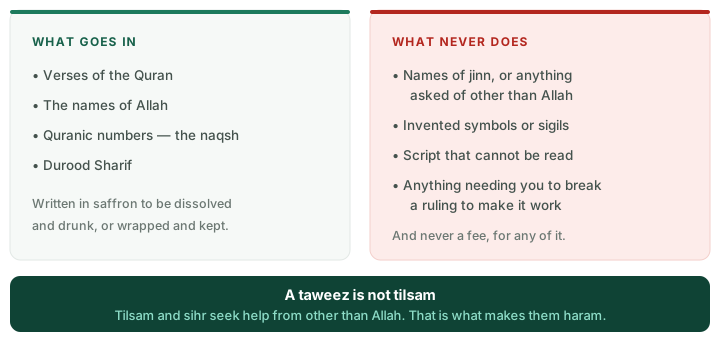
Tilsam and sihr seek help from something other than Allah. That is what makes them what they are. They call on jinn, they use words nobody will explain, they work through something other than the permission of Allah. This is haram, it is dangerous, and the Quran is explicit about it:
"Allah will nullify it. Indeed, Allah does not amend the work of corrupters." — Surah Yunus 10:81
A taweez is Quranic writing. What is on the paper is the word of Allah, His names, Quranic numbers, and Durood Sharif. Nothing is asked of anyone besides Allah. Nothing is hidden inside it that is not from the Book.
The paper is not the thing that heals. Allah heals, by His permission, through His words:
"And We send down of the Quran that which is a healing and a mercy for the believers." — Surah Al-Isra 17:82
Anyone who tells you the object itself has power has already left the boundary. So has anyone who writes a taweez and does not know what he has written.
What goes inside one
There is no mystery here, and you are entitled to know it before you ask for anything:
- Verses of the Quran, written out in Arabic
- The names of Allah, the Asma-ul-Husna
- Quranic numbers, which is what a naqsh is
- Durood Sharif, salutations upon the Prophet (peace be upon him)
And nothing else. No names of jinn. No invented symbols. No script that cannot be read by someone who knows Arabic. No word asking anything of anyone besides Allah.
If that list is not what is inside a taweez, then whatever it is, it is not what we are describing on this page.
The two kinds we write
Before either of them, there is a question worth settling: whether a taweez is the right tool for this person at all. Wazifa, ruqyah or taweez — which one fits which patient.
Written in saffron, to be dissolved. Za'faran ink is used because it dissolves cleanly in water and is safe to drink. The verses are written, the writing is dissolved, and the water is taken. Writing Quranic verses in saffron for a person in difficulty has a long precedent in the tradition - it is reported from Ibn Abbas and recorded by Ibn al-Qayyim in Zad al-Ma'ad.
Written to be kept. The second kind is not dissolved. It is wrapped, and it is kept with the person or placed somewhere clean in the home. This is the kind people mean when they say a taweez is "worn" or "tied".
Which one is appropriate depends on what a person is facing. Neither is a substitute for salah, for the morning and evening adhkar, or for seeing a doctor when the matter is medical.
Why it stays closed, and why that is not the same as hiding
A taweez that is kept rather than dissolved is wrapped and sealed. People sometimes read that as secrecy, so it is worth explaining properly.
It is wrapped because it carries the writing of the Quran. That writing should not be taken into a bathroom, should not get wet and smudged, should not be torn or dropped or thrown away carelessly. Sealing it keeps the text protected and intact. That is adab toward the words of Allah, and it is the reason for the wrapping - not concealment.
You know what is inside it because it is written above. That is the point.
But there is a real warning here, and it is a different one. If a practitioner will not tell you what goes into one - if the answer is evasive, or you are told not to ask, or you are told the contents must remain secret - that is not adab. That is a person with something to conceal. The wrapping is normal. The refusal to explain is not.
Scholars have differed, and you should know that
We would rather say this plainly than let you find it out from someone who uses it against us.
There is a genuine difference of opinion among scholars about written amulets. Narrations exist forbidding tamimah, including:
"Whoever wears an amulet, may Allah not fulfil his need for him." — Musnad Ahmad 17422
Those who permit writing Quran distinguish between two different things: the amulets of jahiliyyah, which carried shirk, unknown words and appeals to other than Allah, and the writing of Quran and the names of Allah, which carries none of that. A number of the Companions are reported to have allowed the latter, and it is the position held across much of the Hanafi tradition, which is the tradition we follow.
Scholars whose opinion we respect take the stricter view. We are not going to pretend they do not exist, and we are not going to tell you the matter is simpler than it is. If your own scholar advises you against it, follow your scholar - and use the recitation in our ruqyah guide instead, which nobody disputes.
What we will never do
These are the boundaries, and they are not negotiable:
- Nothing asked of anyone besides Allah - not jinn, not the dead, not any created thing
- No sihr and no tilsam, including "counter-magic" to undo something done to you. Haram does not become halal because it is aimed at a wrongdoer
- No script or symbol that cannot be explained. If we cannot tell you what a mark means, it does not go on the paper
- No jinn. Nothing we write or recite involves them. Shariah does not permit using them for our tasks, and a practitioner who does is not doing what we do. We explain why here
- Nothing that requires you to break a ruling. We will never tell you to miss a prayer, to stop reciting Quran, or to keep this from your husband or your parents
- No guaranteed result by a date. Nobody can promise that, and claiming to is a claim about the unseen
- No naming a relative as the one who did sihr to you. That shatters families, and it is far more often a technique than a finding
- No asking a woman to attend alone, or at night
If you are dealing with someone and any of these appear, leave - however respected they are locally.
How to look after one
If you are given a taweez to keep:
- Keep it clean and dry, and do not take it into the bathroom
- Do not throw it away when you are finished with it. Bury it in clean ground, or dissolve it in water and pour it somewhere people do not walk
- Do not lend it to someone else. It was written for one person's situation
- Do not treat it as the thing that acts. Allah acts. Keep your salah, keep your adhkar, and keep your doctor's appointments
If you are unsure about something you have been given
If you are already carrying something and you do not know what is in it, or you were told something about your situation that does not sit right, write and tell us. Describe what you were given and what you were told.
Your message stays private, and you receive a Request ID so you can read the reply yourself rather than have it sitting in a chat list on a shared phone. We will tell you plainly what we think.
Sources
- Quran 17:82, 10:81-82
- Sunan Abi Dawud 3893 — words the Prophet (peace be upon him) taught for fear, and their being written
- Musnad Ahmad 17422 — the narration concerning amulets
- Ibn al-Qayyim, Zad al-Ma'ad — writing verses in saffron